Japan Travel Apps 2026: 13 Apps to Download Before You Go
The Japan travel apps worth installing in 2026, by trip stage: train routes, Suica, taxis, translation and food, with English support and phone-number rules.
Driving in Japan as a tourist in 2026: which license papers to carry, the 30 km/h residential road limit from September 1, and how far to drive in a day.
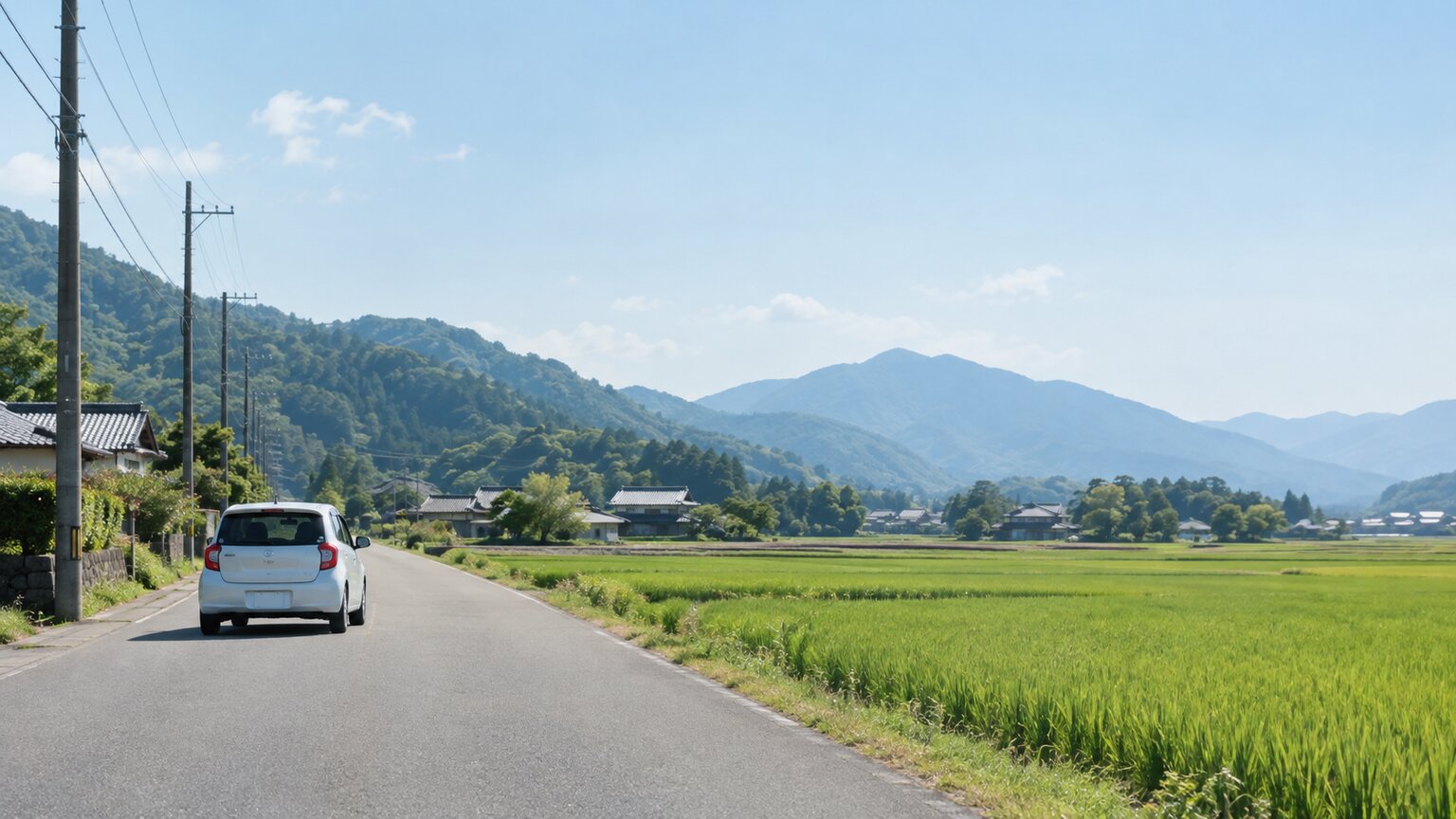
To drive in Japan as a tourist, you need a paper International Driving Permit (IDP) issued under the 1949 Geneva Convention. Licenses from six places use an official Japanese translation instead. Either way, you can drive for one year from your landing date, or until the document expires, whichever comes first. Since September 1, 2026, the legal speed on residential roads with no center line is 30 km/h, down from 60 km/h.
This guide is for visitors from the US, the UK, Canada, Australia and elsewhere who plan to rent a car. It covers three checks: your document, its validity, and the 2026 speed rule.
As of October 2026. This post draws on official government pages, the law text and automobile club pages. Aizzie, mentioned below, is our own trip planner.
Key Takeaways
- Japan accepts only the 1949 Geneva IDP, as a paper booklet. Licenses from Switzerland, Germany, France, Belgium, Monaco and Taiwan use a Japanese translation instead.
- You can drive for one year from landing, or until your IDP or license expires, whichever is shorter. An IDP runs one year from its issue date.
- Since September 1, 2026, unsigned roads with no center line or divider default to 30 km/h. Driving 60 km/h there goes to criminal procedure, not a ticket.
- Plan a break every two hours, and add up each leg's drive time before you fix the day.
Your license country decides your document. Japan recognizes two routes: a 1949 Geneva IDP, or a foreign license with a Japanese translation for six named places (National Police Agency).
| Your document | Valid in Japan? | Carry with it |
|---|---|---|
| 1949 Geneva IDP, paper booklet, from a country that issues the Geneva form | Yes, 1 year from landing or the IDP's own validity, whichever is shorter | Passport. US, UK, Canada: your government says carry your home license too |
| Geneva IDP as a card or phone app | No | n/a |
| 1968 Vienna IDP only (for example, Cuba) | No | n/a |
| IDP from a non-issuer country (for example, Ghana, Zimbabwe, Botswana) | No | n/a |
| License from Switzerland, Germany, France, Belgium, Monaco or Taiwan | Yes, with a Japanese translation, 1 year from landing or the license's validity, whichever is shorter | Original license, translation and passport |
| IDP issued in Taiwan | No | n/a |
| Hong Kong license | No translation route. Use a Geneva IDP from the Transport Department | Hong Kong license (Transport Department advice) |
Sources: NPA, Tokyo Metropolitan Police Department, JNTO, Highway Bureau, MOTC (THB) and Hong Kong Transport Department.
The only IDP that counts is "an International Driving Permit pursuant to the 1949 Geneva Convention on Road Traffic" (NPA). It must be the paper booklet, because card-type and smartphone IDPs are not valid in Japan (JNTO).
The Tokyo Metropolitan Police Department (Keishicho) lists 15 Geneva parties that do not issue the Geneva form, including Ghana, Zimbabwe and Botswana, and Japan does not accept their IDPs (Keishicho). It also lists 13 places where NPA's survey is pending or unanswered, including Nigeria, Jamaica and Barbados. Treat those as not valid until NPA confirms.
For six countries, a government or issuer page backs the 1949 route:
From any other country, find yours on the Keishicho list, then confirm with your licensing body that its IDP follows the 1949 Geneva Convention.
As of April 1, 2026, NPA lists six places whose license works with a Japanese translation: Switzerland, Germany, France, Belgium, Monaco and Taiwan (NPA). The translation must come from the licensing authority that issued the license, its country's consular office, or a body that Japan's National Public Safety Commission has recognized (NPA). Carry it with the original license (JAF).
Taiwan's own IDP is not valid in Japan. Taiwan's Highway Bureau says an "International driving permit issued in Taiwan is not applicable" (THB).
Before you book a rental car, check with the rental company, which can set its own rules on top of these.
Plan your Japan road trip day by day in Aizzie, with each driving leg showing its time and distance.
You can drive for "a period of not more than one year after the date of the driver's landing in Japan or the valid period of the International Driving Permits or foreign driver's licenses, whichever is shorter" (NPA). An IDP is valid for one year from its issue date. So an IDP issued eight months before your trip gives you at most four months in Japan.
The one-year period runs from your landing date, and a new landing starts a new year, up to your permit's own expiry. JAF's English page says: "For holders leaving and re-entering Japan, the validity is one year after reentry" (JAF). Residents on Japan's Basic Resident Register follow a different rule (NPA Q&A).
Your passport proves the landing date. Automated gates do not stamp passports, so JNTO tells renters to use a staffed gate and get an entry stamp (JNTO). Keep the passport in the car, since "a police officer may ask for your passport to confirm the number of days from your entry into Japan" (JAF). For the entry QR codes, see our Visit Japan Web guide.
A tourist cannot switch to a Japanese license. Japan's Cabinet Secretariat states that people on a short-stay status such as sightseeing cannot obtain one (Cabinet Secretariat).
From September 1, 2026, the legal speed for cars on residential roads dropped from 60 km/h to 30 km/h (Metropolitan Police Department). The rule is in Article 11 of the Road Traffic Act's Cabinet Order (e-Gov).
A residential road is one used mainly by local residents in daily life. In a government interview, an NPA traffic regulation official described these as roads without a center line, mainly under 5.5 m wide (Government of Japan Public Relations). You do not need to measure. With no speed sign, look for a center line. No center line means 30 km/h, except on the roads listed below.
Four kinds of road stay at 60 km/h when unsigned (Metropolitan Police Department):
A posted sign always wins. NPA's example is a road with no center line and a 40 km/h sign, where the limit is 40 km/h (Government of Japan Public Relations). On the main carriageway of a national expressway with no sign, the legal limit for a regular car is 100 km/h (JAF, Cabinet Order Article 27). Undivided two-way mainline sections are lower, 60 km/h with no sign (Cabinet Order Articles 27-2 and 11). Treat it as a ceiling when you plan.
The reason is pedestrian safety: the fatality rate rises sharply above 30 km/h (Government of Japan Public Relations).
The JAF English traffic rules page still lists 60 km/h on unsigned ordinary roads (JAF). Follow the Metropolitan Police Department and the law text.
That is 30 km/h over the limit. On a general road, speeding by 30 km/h or more is outside Japan's ticket system and goes through criminal procedure (Road Traffic Act Article 125 and the Cabinet Order's Appended Table 6). It carries 6 points. The court ceiling is up to 6 months' imprisonment or a fine of up to ¥100,000 (Road Traffic Act Article 118).
For an IDP or translation holder, the sanction is a ban on driving in Japan, not a license suspension (Article 107-5). With no prior record, 6 to 14 points means a ban of up to 6 months under the Cabinet Order's standard (Article 40). You hand in the permit, and the ban still applies if you leave and return within the period (e-Gov). This combines the articles. No official page states this example or a typical ban length.
Five rules catch many visitors out: left-hand traffic and right turns, the stop sign, railroad crossings, phone use and drinking. Japan's transport ministry (MLIT) counted rental-car crashes by drivers with an IDP or foreign license rising from 47 in 2020 to 212 in 2025 (MLIT).
| Violation | Official penalty (regular car) |
|---|---|
| Not stopping at a stop sign | ¥7,000 ticket, 2 points |
| Not stopping at a rail crossing | ¥9,000 ticket, 2 points |
| Holding a phone while driving | ¥18,000 ticket, 3 points. Court ceiling 6 months or ¥100,000 |
| Phone use that causes danger | No ticket. Up to 1 year or ¥300,000, 6 points |
| Speeding 30 to under 50 km/h over, general road | No ticket. Criminal procedure, 6 points, driving ban of up to 6 months (no prior record) |
Fines and points come from the Metropolitan Police Department's fine table and points table, with phone penalties from the Government of Japan and NPA. IDP and translation holders can pay these tickets like Japanese drivers (Road Traffic Act Article 125).
Japan drives on the left. Yield to pedestrians, everyone wears a seat belt, a child under six needs a child seat, and you must not use a phone or let the navigation system distract you (JAF).
Right turns are the risk if you drive on the right at home. MLIT points to the high share of crashes during right turns at intersections. It is adding colored right-turn guides, and rubber poles that stop drivers entering the oncoming lane after the turn, near New Chitose, Fukuoka and Naha airports first (MLIT).
Japan's stop sign reads "止まれ" (tomare). At the sign, "you must come to a full stop and check the left and right sides to ensure it is safe to proceed" (NPA). The official wording is a full stop, and the NPA leaflet gives no number of seconds.
Before a railroad crossing, stop at the line and check both ways for trains (JNTO).
NPA's drinking rule is "If you drink, do not drive" (NPA). Drink-driving is outside the ticket system (Government of Japan). After any accident, call the police on 110, even if no one is hurt, and 119 for an ambulance (NPA).
On expressways, rent an ETC card from the rental company and settle the tolls when you return the car (JNTO). Pass through ETC lanes at 20 km/h or less (NEXCO East).
The nationwide Japan Expressway Pass (JEP) has not been sold since December 2023, so older posts that recommend it are out of date (JNTO). Four regional passes remain, for foreign travelers only: Hokkaido, Tohoku, San'in-Setouchi-Shikoku and Kyushu. Each works with a designated ETC card rented with the car. Before you book:
Pass prices change, so this post omits them.
NEXCO East advises a break every two hours at a service or parking area (NEXCO East). JAF warns that some stretches have no fuel stations for a long way, so refuel in advance (JAF).
Size each day of a Japan road trip by adding up each leg's drive time, then add stops. NEXCO East puts New Chitose Airport to Hakodate at about 300 km, and to Shiretoko at about 450 km (NEXCO East). Either is a full day's main move.
The speed limits give the shortest possible drive time. Even at the 100 km/h expressway ceiling, 300 km is three hours of pure driving, and the two-hour break advice adds at least one stop. On a 30 km/h residential road, 15 km takes at least 30 minutes. Real times run longer.
Our planning method, as editorial advice rather than a rule:
To plan this in Aizzie, change a leg's mode to drive, and the itinerary shows that leg's time and distance. Each leg has a Directions link that opens it in Google Maps. If the order of stops is awkward, ask the copilot chat to optimize the route. The times are estimates, so check traffic and closures in a navigation app on the day, such as those in our Japan travel apps guide. Aizzie's core features are free after sign-up, with no credit card or subscription.
| When | What to do |
|---|---|
| Six months or more before | Check your country's route on the Keishicho list. Treat pending and non-issuer countries as not valid |
| Eight weeks before | Get the 1949 IDP or the Japanese translation. Check that its validity covers your trip |
| When you book the car | Ask the rental company about ETC cards and the regional pass for your route |
| One week before | Put the passport, IDP or translation, and home license in one place |
| At landing | Use a staffed gate for the entry stamp. The one-year period starts that day |
For a Taiwan license, a Highway Bureau page dated 2019 lists about 7 to 12 working days for an online application with postal delivery (gov.tw). IDP processing times vary by issuer. If you also ride trains, see Suica on iPhone and Android.
Only with an IDP, since the US is not on Japan's translation list. The U.S. Embassy says an IDP from AAA or AATA is required, and you must also have a valid U.S. driver's license.
It depends on two checks: a valid document route, and adjusting to left-hand traffic and the 30 km/h limit on roads with no center line, in force since September 1, 2026.
The legal speeds are set nationally, by the Cabinet Order. In Tokyo, unsigned roads with no center line have been 30 km/h since September 1, 2026, and the ETC card and break advice above apply too. Size the day by drive time.
No. Japan accepts only 1949 Geneva IDPs, and Taiwan's Highway Bureau says an IDP issued in Taiwan is not applicable in Japan. Carry your Taiwan license with an official Japanese translation and your passport.
No. JNTO says only the paper booklet IDP is valid in Japan.
No. Japan's Cabinet Secretariat says people on a short-stay status such as sightseeing cannot obtain a Japanese license.
GOV.UK says "You'll need the 1949 version of the international driving permit (IDP) plus your UK driving licence and insurance documents with you in the car." You can drive for one year from landing, or until the IDP expires, whichever is shorter.
Read dates are when we last checked each page.
Check your route: a 1949 Geneva paper IDP, or a translation for the six places. Check validity: one year from a stamped landing date, or the document's expiry if sooner. Plan for the speed limit: 30 km/h on roads with no center line since September 1, 2026. For the rest of your arrival steps, see our Visit Japan Web guide.
Add each driving day to your Aizzie trip, see the time and distance of every leg, and adjust the plan with your travel companions.
Found outdated or wrong info?
The Japan travel apps worth installing in 2026, by trip stage: train routes, Suica, taxis, translation and food, with English support and phone-number rules.
The "Will you use Tax-free QR Code?" question is gone. How to set up the tax-free QR on Visit Japan Web and pass the customs check for a Japan refund.
Looking for Wanderlog alternatives? Aizzie vs Wanderlog on free-tier AI limits, offline access, collaboration and input paths, plus the other tools people compare and where Wanderlog still wins.
Plan your trip with Aizzie
Sign up free